Transferring Ownership of a California Vehicle
Buying or selling a vehicle that is already registered in California? Here is what is typically needed to transfer the title. Requirements depend on the vehicle and your situation, so call or text us if you are not sure what applies.
What You Need
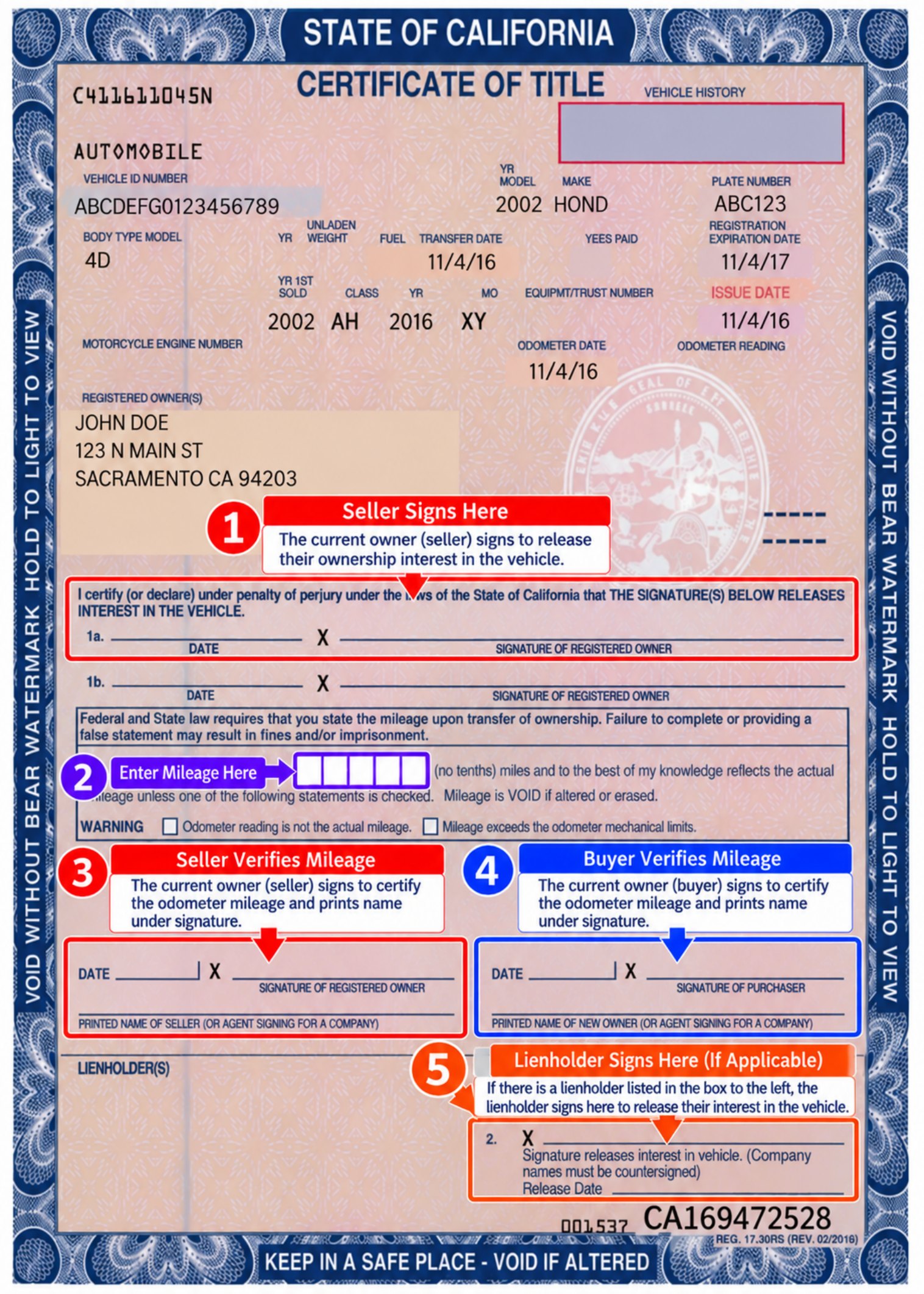
- California title (Line 1a and Line 1b if applicable). The California certificate of title, signed over by the seller to the buyer.
 (opens the full-size image in a new tab)
Sample California title signing guide. Select the image to open it full size. - Lien release (Line 2). If a lienholder is listed on the title, a release of the lien is needed.
- Smog certification. The seller is responsible for providing a smog certification, when one is required for the vehicle. See Smog Check requirements below.
Transfer Deadlines
- Buyer. The buyer has 10 calendar days from the sale date to transfer ownership.
- Seller. The seller has only five days from the sale date to submit the Notice of Transfer and Release of Liability.
Smog Check Requirements
A Smog Check is generally required when a California vehicle changes ownership. Here are the key points:
- Seller’s responsibility. The seller must have the Smog Check done and give the buyer a copy of the vehicle inspection report.
- 90-day window. For a private-party sale, the vehicle must have passed a Smog Check within the last 90 days. A passing result is sent electronically to the DMV.
- Failed Smog Check. If the vehicle fails, the seller is responsible for completing repairs and retesting.
- Family transfers. Transfers between immediate family members do not require a Smog Check.
- Exempt vehicles. No Smog Check is needed for gasoline, hybrid and alternative-fuel vehicles four model years old or newer (a smog transfer fee is paid to the DMV with the title transfer), gasoline vehicles 1975 and older, electric vehicles, motorcycles, diesel vehicles 1997 and older, and diesel vehicles over 14,000 lbs gross vehicle weight.
- Out-of-state vehicles. A Smog Check is required to register a vehicle in California for the first time.
Source: California Bureau of Automotive Repair (BAR) (opens in a new tab). Rules can change, so call or text us if you are not sure what applies to your vehicle.
Odometer Mileage Reporting
Federal law (the Truth in Mileage Act of 1986) requires an odometer mileage disclosure when ownership of most newer vehicles changes. The DMV collects it on original registration and registered-owner transfer applications. Key points:
- Original signatures. The seller and the buyer must sign. Signatures by power of attorney are not accepted.
- Handprinted names. An individual buyer or seller must handprint their name and sign by hand.
- Multiple owners. If more than one owner is shown on the title, the original signature of one seller and one buyer is enough.
- Mileage must match. The odometer mileage must be reported the same way on every document, including the title, the Report of Sale and the REG 262.
- Exemptions. Disclosure depends on the vehicle’s model year:
- Model year 2011 and newer: required until the vehicle is 20 model years old. After that it is exempt. For example, a 2011 model becomes exempt in 2031.
- Model year 2010 and older: required only for vehicles nine model years old and newer. Older vehicles are exempt.
Source: California DMV, Odometer Mileage Reporting (opens in a new tab).
Questions?
Call or Text: (714) 730-6850
Email: info@mikeservi.com